How Manufacturers Lose Money Through Small IT Problems
Manufacturing leaders often think about IT risk in terms of ransomware, major outages, or a catastrophic cyberattack. Those threats deserve attention, but they are not always what causes the most disruption.
In many manufacturing environments, production delays are caused by small operational technology problems that gradually become expensive. A network switch fails. An ERP integration stops working. A vendor misses a software update. A backup process silently breaks. Individually, these issues may seem minor. Together, they can interrupt production schedules, delay shipments, create inventory inaccuracies, and consume valuable staff time.
For manufacturers across Eugene, Springfield, Lane County, and the broader Willamette Valley, operational resilience often depends less on preventing dramatic events and more on managing the everyday technology systems that keep production moving.
Production Interruptions Are Often Technology Problems in Disguise
When a production line slows or stops, attention naturally focuses on machinery, staffing, materials, or scheduling. However, technology frequently sits underneath all of those functions.
Modern manufacturing relies on a complex chain of connected systems. Production equipment may communicate with inventory software. Warehouse teams depend on barcode scanners and wireless networks. Supervisors rely on scheduling systems, reporting tools, and production dashboards.
A seemingly small issue can create a ripple effect:
- A workstation on the plant floor loses connectivity.
- Production data stops syncing with the ERP platform.
- Inventory counts become inaccurate.
- Pick lists contain outdated information.
- Shipping schedules fall behind.
The financial impact is rarely limited to the initial technical problem. Delayed orders, overtime costs, rushed shipping expenses, and customer dissatisfaction can quickly outweigh the cost of the original issue.
The challenge for many manufacturers is that these operational failures appear unrelated until someone traces them back to the underlying technology dependency.
ERP Systems Have Become Critical Business Infrastructure
For many manufacturers, the ERP platform is the operational center of the business.
Order processing, inventory management, purchasing, production planning, accounting, and reporting often depend on a single system. If that system becomes unavailable or partially impaired, multiple departments can be affected simultaneously.
The risk is not always a complete outage.
More commonly, manufacturers encounter issues such as:
- Failed integrations between business applications
- Software updates that cause unexpected disruptions
- Vendor support delays
- Data synchronization errors
- Unplanned server maintenance
Because ERP systems touch so many workflows, even brief interruptions can create confusion throughout the organization.
A purchasing team may not have accurate inventory data. Production managers may struggle to prioritize work orders. Accounting could experience delays in invoicing and reporting. Customer service representatives may not have visibility into order status.
Business leaders often underestimate the operational dependency created by these platforms until a problem occurs.
Understanding how critical systems connect throughout the organization is an important part of business continuity planning. If production depends on a single software platform, leaders should know exactly what happens when that platform becomes unavailable.
Network Reliability Directly Affects Production
Manufacturing operations increasingly rely on network connectivity.
Wireless devices, cloud applications, production monitoring systems, remote vendor support, VoIP communication platforms, inventory tracking systems, and security systems all depend on a reliable network.
Unfortunately, network problems often develop gradually.
A switch begins failing intermittently. Wireless coverage degrades in part of the facility. Aging infrastructure struggles to support new equipment. Documentation becomes outdated after years of changes.
The result might not be a complete outage.
Instead, employees experience small but frequent interruptions:
- Slow application performance
- Intermittent disconnections
- Delayed file transfers
- Unreliable device communication
- Production data synchronization issues
Each interruption may last only a few minutes, but the cumulative effect can be significant. Lost productivity across dozens of employees and production staff adds up quickly.
Manufacturers sometimes accept these issues as normal operational frustrations. In reality, they are often indicators of infrastructure that requires attention.
Operational resilience depends on treating network reliability as a production requirement rather than simply an IT concern.
Vendor Coordination Is an Overlooked Risk
Manufacturing organizations frequently depend on numerous outside vendors.
A typical operation might work with separate providers for:
- ERP software
- Manufacturing equipment
- Industrial control systems
- Telecommunications
- Internet services
- Cloud applications
- Security systems
- Managed IT services
When a problem occurs, determining responsibility can become a challenge.
One vendor may identify a network issue. Another may point to software updates. A third may suggest the problem originates from the equipment itself.
Meanwhile, production delays continue.
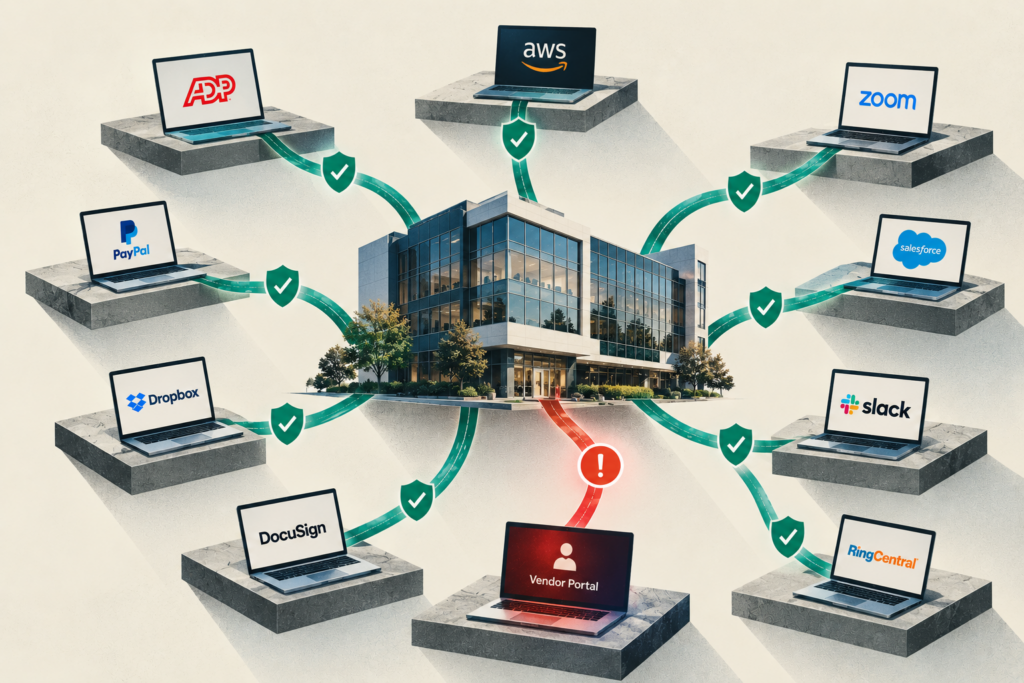
Many manufacturers discover that technical troubleshooting becomes significantly harder when multiple vendors are involved but no one owns overall coordination.
This is one reason strategic IT planning matters. Someone must maintain visibility into how systems interact, document vendor relationships, and coordinate responses when issues arise.
Without that oversight, organizations often spend more time managing vendors than resolving problems.
A well-defined support structure helps reduce delays, improve accountability, and speed recovery when disruptions occur.
Risk Reduction Starts With Planning
Manufacturers cannot eliminate every technology failure. Equipment ages, software develops bugs, and vendors occasionally make mistakes.
The goal is not perfection.
The goal is reducing the business impact when problems occur.
Practical risk reduction strategies often include:
Documenting Critical Systems
Leadership should understand which systems directly affect production, inventory management, shipping, and customer fulfillment.
When a disruption occurs, teams need clear visibility into what is affected and how operations should continue.
Evaluating Single Points of Failure
Many organizations unknowingly rely on one server, one network component, one internet connection, or one key employee with institutional knowledge.
Identifying those dependencies helps prevent routine issues from becoming major operational problems.
Testing Business Continuity Procedures
A business continuity plan should go beyond cybersecurity scenarios.
Manufacturers should consider:
- ERP downtime
- Internet service interruptions
- Vendor outages
- Hardware failures
- Communication disruptions
Testing response procedures often reveals gaps before a real event occurs.
Maintaining Vendor Oversight
Businesses should know who supports each critical system, how support requests are escalated, and who coordinates response efforts across vendors.
Strong documentation reduces confusion during stressful situations.
Aligning IT With Operational Goals
Technology decisions should support production objectives, not operate independently from them.
Regular reviews of infrastructure, support processes, and business continuity capabilities help ensure technology remains aligned with operational needs.
Small Problems Often Create the Biggest Costs
The manufacturing organizations that experience the least disruption are not necessarily the ones with the largest technology budgets. They are usually the ones with the best visibility into their operational dependencies.
A failed network device, a malfunctioning ERP integration, or an unresolved vendor issue may not sound dramatic. Yet these routine problems can create costly production interruptions when the business is not prepared.
For manufacturers throughout the Willamette Valley, operational resilience increasingly depends on understanding how technology supports every stage of production and fulfillment. Small IT problems rarely stay small when they affect manufacturing workflows.
Business leaders should regularly review critical technology dependencies, continuity plans, vendor relationships, and infrastructure risks before issues arise. Emerald Technology Group works with manufacturing organizations to identify operational vulnerabilities, improve business continuity planning, coordinate vendor relationships, and ensure technology supports production goals reliably and responsibly. The result is not just better IT performance, but a more resilient manufacturing operation.
What to read next
Back to Blogs