What to Do When a Vendor Suffers a Data Breach
Your Vendor Has a Breach. Now What?
For many organizations across Eugene, Springfield, and the broader Willamette Valley, cybersecurity planning often focuses on their own systems, employees, and technology infrastructure. Yet one of the most significant risks to business continuity may originate outside their walls.
A growing number of cybersecurity incidents begin with a trusted vendor, software provider, cloud platform, billing service, or managed business partner. When a third party experiences a breach, the consequences can quickly spread to the businesses that depend on them. Client information may be exposed, operations disrupted, compliance obligations triggered, and stakeholder confidence tested.
The reality is simple: third-party risk increasingly becomes your problem whether you caused it or not.
Understanding how to respond when a vendor has a breach is an important part of modern cybersecurity vendor management and organizational resilience.
Supply Chain Exposure Is Larger Than Most Organizations Realize
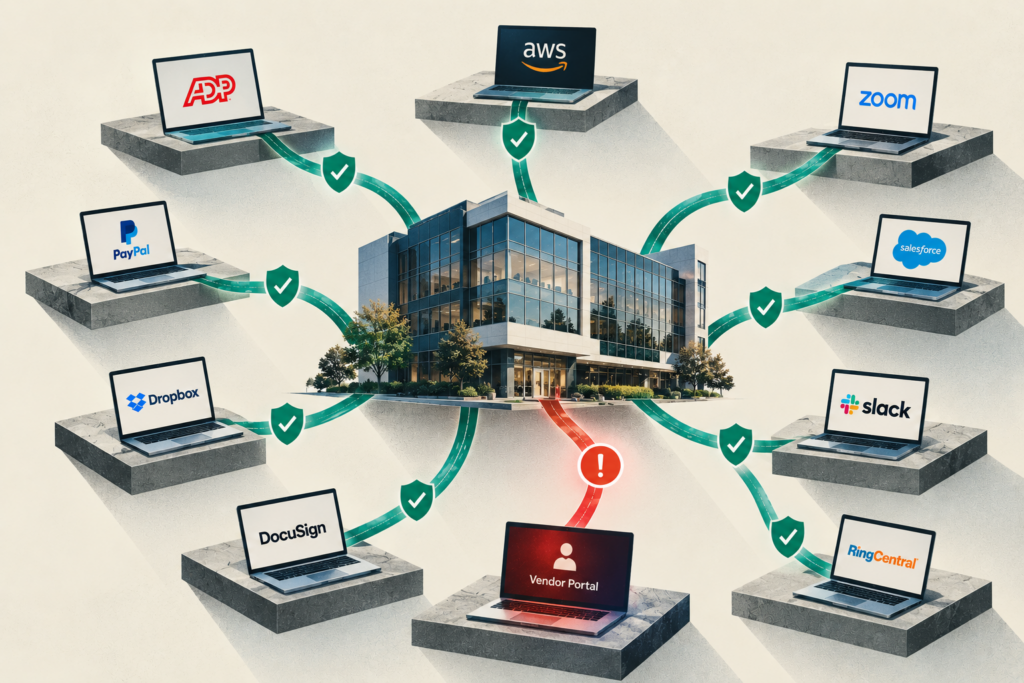
Most businesses rely on dozens of external technology providers, often without fully appreciating the level of access those vendors possess.
Healthcare organizations may depend on electronic medical records providers, billing platforms, and patient communication systems. Property management firms often use payment platforms, resident portals, and maintenance management software. Professional services firms may store confidential client information within cloud-based applications used for accounting, document management, or customer relationship management.
Each vendor relationship creates a potential connection to sensitive information and critical business processes.
A third-party breach does not necessarily mean your organization has been directly compromised. However, it does mean your organization must immediately understand whether data, accounts, systems, or operational processes are affected.
In many recent cybersecurity incidents, attackers have targeted software supply chains specifically because a single vendor can provide access to hundreds or thousands of downstream customers. This makes vendor risk a critical business concern rather than simply an IT issue.
Leadership teams should view third-party relationships as extensions of their own operational environment and evaluate them accordingly.
Review Contractual Obligations Before You Need Them
One of the first questions that arises following a third-party breach is often, “What is the vendor required to do?”
The answer should already exist in the contract.
Many organizations focus heavily on pricing, service levels, and implementation details during procurement but spend less time reviewing cybersecurity and breach notification language. Unfortunately, those provisions become extremely important when an incident occurs.
Key contract considerations often include:
- Breach notification requirements
- Incident response cooperation expectations
- Cybersecurity insurance requirements
- Data ownership and protection responsibilities
- Regulatory compliance obligations
- Rights to audit or request security information
- Service continuity expectations during an incident
For organizations operating in regulated industries, these provisions can be particularly important. Healthcare providers may face obligations relating to protected health information. Professional service firms may have contractual duties to safeguard client data. Property management organizations often handle financial and personal information that carries privacy obligations.
Clear contractual language helps reduce uncertainty during an already stressful event.
If leadership cannot easily identify what a vendor must do following a breach, it may be worth revisiting vendor agreements before an incident occurs.
Communication Planning Matters More Than Technical Details
When a trusted vendor announces a security incident, uncertainty often becomes the greatest challenge.
Employees want answers. Clients may have questions. Regulatory obligations may require notifications. Leadership needs reliable information to make informed decisions.
The instinct to communicate immediately is understandable, but organizations should avoid speculation.
Instead, businesses should have a communication framework that addresses:
- Internal leadership communications
- Employee guidance
- Client and customer notifications
- Regulatory reporting obligations
- Vendor coordination procedures
- Media inquiries when applicable
An effective communication plan focuses on transparency without creating unnecessary confusion.
Business leaders should remember that stakeholders often judge organizations less by the existence of an incident and more by how responsibly it is handled. Clear, measured communication can help preserve trust even during difficult circumstances.
This is particularly important for healthcare practices, law firms, accounting firms, and other professional services organizations where confidentiality and credibility are essential business assets.
Focus on Business Impact During the Technical Response
When news of a vendor breach emerges, technical teams naturally begin gathering information. While that work is important, leadership should focus on understanding business impact rather than getting lost in technical details.
Questions worth asking include:
- Does the vendor have access to our sensitive information?
- Are any business operations disrupted?
- Could client data be affected?
- Do we need to notify regulators, insurers, or customers?
- Are alternative processes available if systems become unavailable?
- Are any user accounts or integrations connected to the vendor at risk?
Depending on the circumstances, organizations may need to temporarily suspend integrations, reset credentials, monitor for unusual activity, or activate elements of their business continuity plan.
The goal is not panic. The goal is informed risk management.
Many organizations discover during a third-party incident that they lack a complete inventory of vendor relationships, system integrations, and data flows. This can significantly delay response efforts.
Maintaining accurate documentation, conducting regular security assessments, and incorporating vendor dependencies into strategic IT planning can help reduce uncertainty when incidents occur.
Vendor Risk Reviews Should Be Ongoing
A vendor breach often reveals weaknesses that existed long before the incident happened.
Perhaps security reviews were never completed. Maybe contracts lacked adequate protections. Sometimes organizations simply inherited software relationships that were never formally evaluated.
Effective cybersecurity vendor management is not a one-time procurement exercise.
Organizations should periodically review vendors based on factors such as:
- Access to sensitive information
- Operational criticality
- Regulatory requirements
- Security maturity
- Incident history
- Business continuity capabilities
- Compliance certifications or assessments
High-risk vendors typically deserve greater scrutiny than low-risk service providers.
Regular vendor assessments can help leadership identify concerns before they become emergencies. They also support compliance initiatives, cybersecurity insurance requirements, and broader governance objectives.
For organizations with limited internal IT resources, partnering with experienced advisors can provide structure and consistency to vendor oversight efforts.
Third-Party Risk Is Now a Leadership Responsibility
Cybersecurity discussions frequently focus on attackers, ransomware, malware, and internal security controls. Yet some of the most disruptive incidents originate from trusted third parties that organizations depend on every day.
The challenge is not eliminating vendor risk entirely. That is neither practical nor realistic. The objective is understanding the risk, documenting responsibilities, preparing response procedures, and ensuring the organization can continue operating if a critical vendor experiences a security event.
Business leaders should know which vendors have access to sensitive information, what contractual protections exist, how incidents will be communicated, and how operational continuity will be maintained when disruptions occur.
Organizations throughout Lane County and the Willamette Valley increasingly rely on complex networks of technology providers to support daily operations. As those relationships grow, so does the importance of structured vendor risk management and business continuity planning.
Emerald Technology Group works with healthcare practices, professional services firms, property management companies, and other organizations to evaluate vendor risk, strengthen cybersecurity governance, support compliance requirements, and align technology decisions with broader business objectives. Taking the time to understand third-party exposure today can make future incident response more effective, more organized, and far less disruptive.
What to read next
Back to Blogs